Missions With the Consfords
August 7, 2026
I remember sitting under a mango tree in a village outside Kumasi, Ghana, trying to explain the resurrection of Jesus Christ to an elder who believed his ancestors still walked…
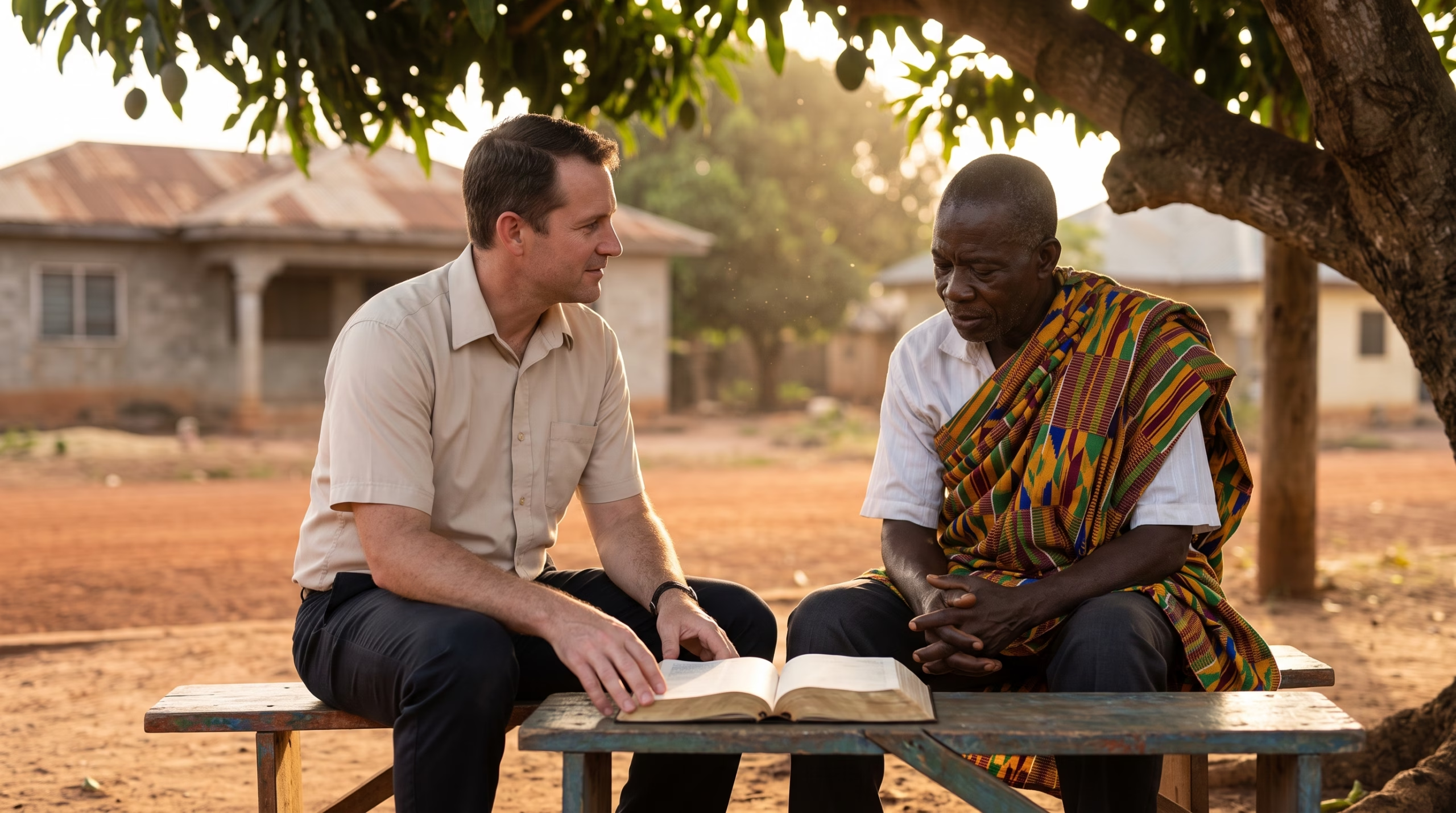
I remember sitting under a mango tree in a village outside Kumasi, Ghana, trying to explain the resurrection of Jesus Christ to an elder who believed his ancestors still walked among us. He was a kind man, full of wisdom in his own traditions, but his understanding of the spiritual world was built on a different foundation entirely. That day, I learned firsthand the absolute necessity of apologetics in Ghana missions. It wasn’t about winning an argument; it was about clearly presenting the truth of the Gospel in a way that truly made sense.
Our work here in Ghana, planting churches and sharing the Good News, often brings us face to face with deeply held traditional beliefs. People ask honest questions, sometimes challenging ones. They want to know why our God is the only God, or how a man can rise from the dead. These aren’t just academic debates. These are real people wrestling with eternal truths, and we have a sacred duty to give them answers that stand firm.
Understanding the Need for Apologetics in Ghana Missions
When Laura and I first arrived in West Africa, I thought my main job was just to preach. And it is. But I quickly realized that before you can preach effectively, you often need to lay some groundwork. Folks here already have a worldview. They understand spiritual power. They believe in gods and spirits. The challenge isn’t always introducing the idea of the spiritual, but introducing the *right* spiritual truth.
We see a lot of syncretism, which is when people try to blend Christianity with their old beliefs. They might come to church on Sunday, but still consult a fetish priest on Monday for protection or healing. This isn’t a lack of faith; it’s often a lack of understanding about the exclusive nature of Christ. Apologetics, then, becomes the gentle, firm hand that guides them to see the true, all-sufficient power of the Lord Jesus Christ.
Addressing Spiritual Strongholds and Cultural Beliefs
Ghana is a nation rich in culture and history, and with that comes a deep respect for traditions, ancestors, and often, a fear of evil spirits. People believe in juju, curses, and the power of witch doctors. To simply say, “Jesus saves” without addressing these deeply ingrained fears is to leave a huge gap in their understanding. We have to show them that Jesus isn’t just *a* god, but the only God, sovereign over all creation and every spiritual power.
I remember one young man, bright as a button, who came to our church. He loved the singing and the fellowship, but he admitted to me that he was still afraid of a curse placed on his family years ago. I sat with him, Bible open, and showed him verses like, “There is no enchantment against Jacob, neither is there any divination against Israel: according to this time it shall be said of Jacob and of Israel, What hath God wrought!” (Numbers 23:23). We talked about how God’s power is supreme, and that in Christ, he was a new creature, free from all such bondages. That was apologetics in action, directly addressing a real fear with God’s truth.
Building a Foundation of Biblical Truth
Apologetics isn’t just for intellectuals or seminary professors. It’s for every believer called to “earnestly contend for the faith which was once delivered unto the saints” (Jude 1:3). For us on the mission field, it means being ready to explain *why* we believe what we believe, using the King James Bible as our ultimate authority. It means knowing the scriptures well enough to answer questions about creation, the problem of evil, the uniqueness of Christ, and the reliability of the Bible itself.
Many of the people we reach have never had the opportunity for formal education, let alone theological training. They rely on what they see and hear. Therefore, our explanations need to be clear, simple, and rooted firmly in God’s Word. We can’t just tell them “God said it.” We need to help them understand *how* God said it, and why it matters to them right now.
The Power of a Consistent Testimony
Beyond words, our lives are a powerful form of apologetics. When people see Laura and I live out our faith, when they see us forgive, serve, and trust God through difficulties, it speaks volumes. It’s one thing to preach about God’s love; it’s another to demonstrate it when a brother needs help or when a challenge arises in the community. Our actions often create the questions that our words then answer.
I’ve seen hardened hearts soften not because of a theological argument, but because they witnessed genuine Christian love in action. Then, when they ask, “Why are you like this?” we get to explain the source of that love. That’s a powerful entry point for the Gospel. According to the International Mission Board, more than 3,400 people groups remain unreached by the Gospel, many of them in regions with strong traditional religious systems that require careful and compassionate engagement.
“More than 3,400 people groups remain unreached by the Gospel, many of them in regions with strong traditional religious systems that require careful and compassionate engagement.”
International Mission Board
Practical Apologetics on the Field
So, what does apologetics look like day-to-day in Ghana? It’s not always a formal debate. More often, it’s a conversation over a meal, a discussion during a village visit, or an answer to a question whispered after a Bible study. It’s about being prepared, always, to give an answer.
“But sanctify the Lord God in your hearts: and be ready always to give an answer to every man that asketh you a reason of the hope that is in you with meekness and fear” (1 Peter 3:15). This verse isn’t just for show. It’s our marching orders. It means we need to study, pray, and think through the common objections and questions we might face.
Responding to Common Objections
Some of the questions we hear often revolve around suffering. “If God is good, why is there so much sickness and poverty?” Others question the exclusivity of Christ. “Are you saying my ancestors are in hell because they didn’t know Jesus?” These are tough questions, and they deserve honest, biblical answers, not platitudes.
I remember one time a man asked me why God would allow his child to die if He loved him. My heart ached for him. I didn’t have a glib answer. I just sat with him and shared from the Word about God’s sovereignty, His comfort, and the promise of heaven. I didn’t pretend to understand all of God’s ways, but I pointed him to the character of God as revealed in scripture. Sometimes, the most powerful apologetic is simply walking with someone through their pain and pointing them to the God who cares.
Missionary on Fire Podcast
Preserving the Legacy of Faithful Missionaries
The Missionary on Fire podcast features interviews with veteran missionaries, classic sermons from the field, and stories of God’s faithfulness across generations. If you love the heart behind these stories, you will love the podcast. New episodes regularly.
Apologetics as a Lifestyle of Learning and Sharing
For us, apologetics in Ghana missions isn’t a separate subject we study; it’s woven into the fabric of our daily lives. It means continually learning about the culture, the local worldview, and the specific spiritual challenges people face. It means not being afraid to say, “I don’t know, but let’s look at what the Bible says together.”
Laura and I have spent years learning Twi, the local language, not just to preach, but to understand the nuances of thought and belief. Sometimes a single word can carry a whole worldview. Knowing that helps us explain the Gospel more clearly, bridging the gap between two very different ways of seeing the world. This ongoing learning is part of being a missionary on fire for God.
Building Relationships of Trust
True apologetics happens in the context of relationship. People don’t care how much you know until they know how much you care. We’ve spent years building trust in the communities where we serve. We’ve shared meals, attended funerals, celebrated births, and sat through endless discussions. When you earn that trust, people are far more likely to listen when you share about your faith.
I remember a time when our truck broke down, and a local mechanic, who had always been skeptical of our message, spent days helping me fix it, refusing payment. Later, he told me, “You people are different.” That opened the door for a conversation about Jesus that wouldn’t have happened otherwise. It got fixed because of relationships.
The Unchanging Word in a Changing World
Ultimately, the power of apologetics comes from the power of God’s Word. Our job is not to invent clever arguments, but to clearly articulate the truth that God has already revealed. The KJV Bible is sufficient. It has the answers, it has the power, and it needs no help from us to be true.
We’ve seen lives transformed by the simple, straightforward preaching of the Gospel, backed by a willingness to explain and defend the faith. It’s not always easy. Sometimes it’s frustrating. But seeing someone grasp the truth of Christ, seeing them leave behind old fears and embrace new life in Him, makes every difficult conversation, every challenging question, absolutely worth it. If you want to dive deeper into the kind of challenges and triumphs we face, you can always check out more of our stories on the blog.
The mission field does not reward drama. It rewards endurance. It rewards those who are willing to study again, visit again, preach again, forgive again, and trust God again. This is the heart of our ministry, and it’s why we believe so strongly in the vital role of biblical apologetics in our work.
Our goal is to see vibrant, Bible-believing churches planted across Ghana, filled with believers who are not only saved but grounded in the truth and able to defend their faith. This requires diligence, patience, and a deep reliance on the Holy Spirit. If you’re passionate about seeing lives changed and churches established, I encourage you to learn more about our vision and how you can be a part of it. The principles of a dedicated, Spirit-filled life on the mission field are at the core of what we share on Missionary on Fire.

Joe Consford is a Baptist missionary serving in Ghana, West Africa, with his wife Laura. He writes about missionary life, missions training, and the work of the Gospel in West Africa at consfords.com.
Frequently Asked Questions
What is Christian apologetics in the context of missions?
Christian apologetics in missions involves defending and explaining the Christian faith to those from different worldviews. It’s about providing clear, reasoned answers to questions and objections, helping people understand the truth of the Gospel in their cultural context. This is particularly crucial for apologetics in Ghana missions.
How do missionaries address syncretism in Ghanaian churches?
Missionaries address syncretism by clearly teaching the exclusive nature of Christ and the sufficiency of God’s power. They gently guide new believers to understand that blending Christianity with traditional beliefs, like consulting fetish priests, is incompatible with true faith. This often involves patient, ongoing discipleship and apologetics in Ghana missions.
What specific traditional beliefs do missionaries encounter in Ghana?
Missionaries in Ghana frequently encounter beliefs in ancestral spirits, juju, curses, and the power of witch doctors. These deeply ingrained fears and traditions require careful, biblically-grounded responses. Apologetics helps show that Jesus is sovereign over all spiritual powers, offering true freedom and protection.
How does apologetics help overcome fear of evil spirits in West African cultures?
Apologetics helps overcome fear of evil spirits by demonstrating God’s ultimate sovereignty and power over all creation. Missionaries use scripture to show that believers are protected in Christ, dispelling fears related to curses or divination. This provides a solid foundation for faith, replacing fear with trust in God’s omnipotence.