Missions With the Consfords
August 6, 2026
I remember sitting in a small, mud-brick church in a remote village in Ghana, trying to explain the concept of eternal life. The elder, a wise man with kind eyes,…
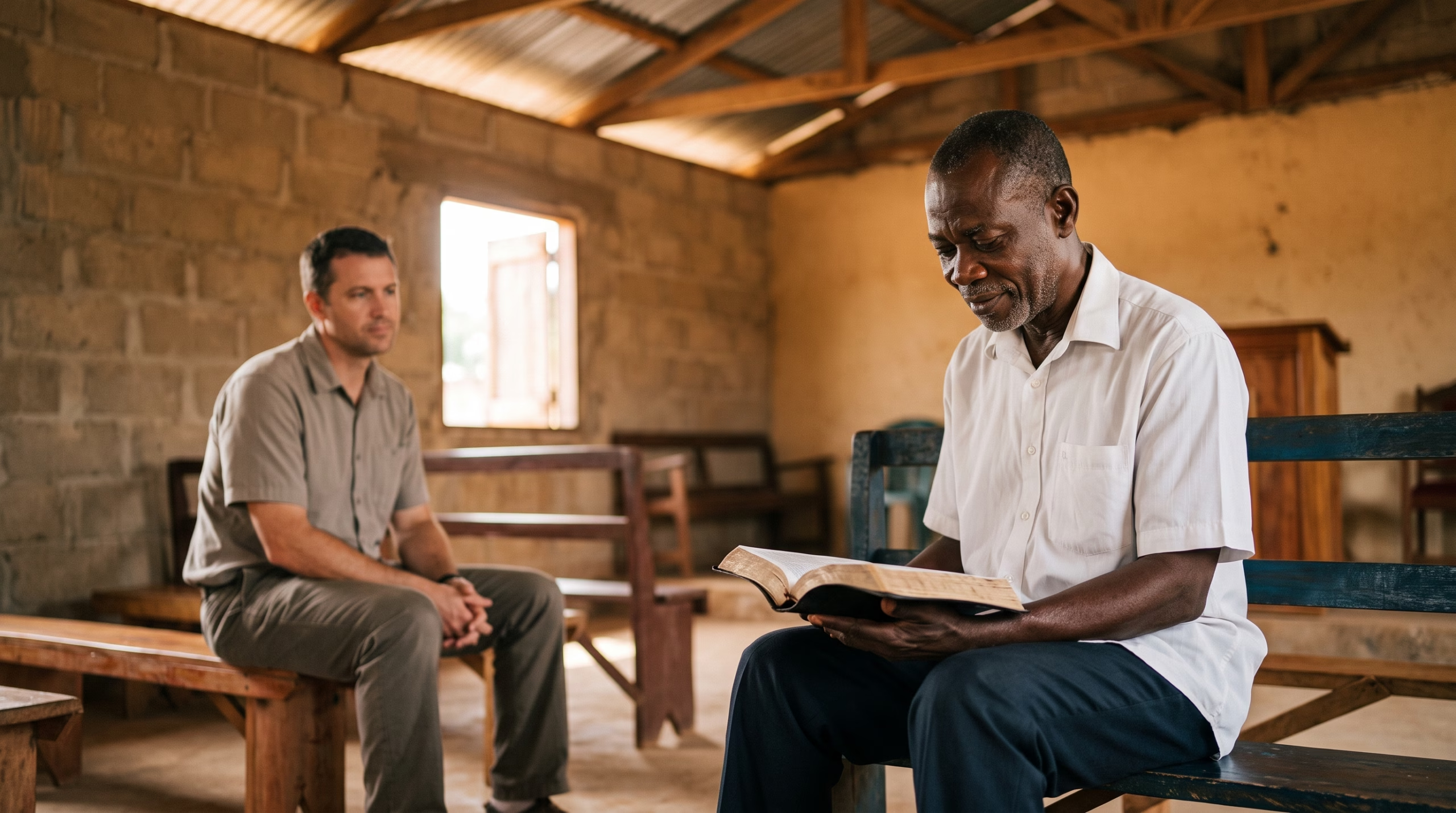
I remember sitting in a small, mud-brick church in a remote village in Ghana, trying to explain the concept of eternal life. The elder, a wise man with kind eyes, nodded slowly. Then he asked, “So, if your father dies, he goes to heaven. But he is still your father. Can he not visit you?” It wasn’t a challenge. It was a genuine question, born from a worldview where ancestors are very much present and influential. That moment crystallized for me one of the primary gospel barriers in missions: it’s not just about translating words, but translating entire worldviews.
My wife Laura and I have spent years on the field, and we’ve learned that the Good News doesn’t always travel a straight path. There are hills to climb, rivers to cross, and deep cultural chasms to bridge. These are the barriers that stand between a lost soul and the truth of Jesus Christ.
The Language Barrier: More Than Just Words
When we first arrived in Ghana, the language was a wall. I learned Twi, a major local language, and I learned it the hard way – by making a lot of mistakes. I once tried to say I was “thirsty” but instead said I was “pregnant.” That went about as well as you would expect. People laughed, and I laughed with them. But the real challenge wasn’t just pronunciation; it was conveying spiritual truths with accuracy and cultural relevance.
You can translate “God so loved the world” word for word, but if “love” in the local context primarily means reciprocal exchange, then the idea of unmerited grace can be lost. We had to dig deeper, finding analogies and stories from their own culture that could illuminate God’s unconditional love. It meant hours of study, not just of vocabulary, but of idiom and worldview. It meant listening more than speaking.
The KJV tells us, “How then shall they call on him in whom they have not believed? and how shall they believe in him of whom they have not heard? and how shall they hear without a preacher?” (Romans 10:14). That “hearing” isn’t just about sound waves. It’s about comprehension. It’s about the message landing in their heart and making sense in their world. We’ve seen God open doors of understanding when we faithfully, patiently, work through the language.
Cultural Walls: Understanding the Worldview
Beyond language, culture presents its own set of gospel barriers in missions. In Ghana, family and community are paramount. Individualism, as understood in the West, is often seen as selfish. This impacts how people view a personal relationship with Christ. If salvation is seen as separating you from your family’s traditional beliefs, it can be a terrifying prospect.
We’ve spent countless hours in homes, drinking warm Fanta and talking about family, ancestors, and the spirits that are believed to influence daily life. Only after building trust and understanding these foundational beliefs could we begin to present the Gospel in a way that honored their culture while still proclaiming the truth. We had to show that Christ came not to destroy culture, but to redeem it. We had to explain that God is the ultimate Father, and the church is the ultimate family.
The Barrier of Distrust and Skepticism
The mission field does not reward drama. It rewards endurance. It rewards consistency. Over the years, many people have come to Ghana offering help, making promises, and then disappearing. There’s a natural skepticism towards outsiders, especially those who come with a “new” message. Sometimes, the only way to overcome this gospel barrier is to simply stay.
We’ve learned that our actions often speak louder than our words for a long time. When our truck broke down on a terrible road, we fixed it. When someone was sick, we prayed and helped get them to the clinic. When we said we would be somewhere, we were there. This kind of consistent presence builds trust slowly, brick by brick. People watch you. They see if your walk matches your talk.
“Today, there are 3.4 billion people who live in places where there is little to no access to the gospel.”
International Mission Board
That statistic is a heavy one. It reminds us why we do what we do. Those billions are not just numbers; they are individuals like the man who asked about his visiting father. They are waiting for someone to consistently show up and break down those walls of distrust.
Physical and Practical Hurdles
Sometimes, the gospel barriers in missions aren’t spiritual or cultural; they’re simply physical. Imagine wanting to share the gospel in a village that’s a five-hour drive on dirt roads, only accessible by a rickety bridge during dry season, and has no electricity or running water. Then imagine your vehicle breaks down, which it always does.
These are the realities of church planting in remote areas of West Africa. Sickness, lack of resources, difficult terrain, and the sheer effort required to travel can all be significant hurdles. We’ve hauled building materials on our heads, walked for miles in the scorching sun, and slept in places where the mosquitoes outnumbered the stars. But every step is worth it when you see a new church gathering, or hear someone sing praises to Jesus for the first time.
Missionary on Fire Podcast
Preserving the Legacy of Faithful Missionaries
The Missionary on Fire podcast features interviews with veteran missionaries, classic sermons from the field, and stories of God’s faithfulness across generations. If you love the heart behind these stories, you will love the podcast. New episodes regularly.
We had to learn to be resourceful. We had to embrace the fact that ministry here often looks less like a polished service and more like a rough-and-tumble adventure. The Lord provides, always. He gives us strength for the journey, wisdom for the problems, and a joy that overcomes the discomfort. If you want to know more about the gritty reality of missionary life, check out my book, “That’s My Goat!”
Spiritual Warfare: The Real Enemy
Ultimately, all these gospel barriers in missions, whether language, culture, or practical, point to a deeper spiritual reality. We are not just fighting flesh and blood; we are in a spiritual battle. The enemy does not want souls saved, and he will use every tool at his disposal to hinder the spread of the Gospel. In Ghana, where traditional beliefs about spirits and witchcraft are prevalent, this spiritual warfare is often very tangible.
We’ve seen people bound by fear, believing curses or evil spirits control their lives. We’ve witnessed the power of Christ break those chains. This is where prayer becomes not just a nice idea, but an absolute necessity. We pray for open doors, for understanding, for protection, and for God’s power to convict and convert. We know that “the weapons of our warfare are not carnal, but mighty through God to the pulling down of strong holds” (2 Corinthians 10:4).
When we face an obstacle that seems insurmountable, we remember that we are not alone. God is with us, and He is greater than any barrier. We depend on His power, not our own. Sometimes, the only way through is on our knees. You can join us in this fight by visiting our prayer letters page and signing up for updates.
Overcoming with God’s Power
Overcoming gospel barriers in missions is the daily work of a missionary. It’s not glamorous. It’s often frustrating. But it is always rewarding. It requires patience, humility, and an unwavering reliance on God. We study again. We visit again. We preach again. We forgive again. We trust God again. This is the enduring spirit of mission work.
God has called us to “Go ye therefore, and teach all nations” (Matthew 28:19). He didn’t say it would be easy. He just said to go. And He promised He would be with us always. That promise makes all the difference. It’s what keeps us going, even when the barriers seem high. If you feel that same fire in your bones, that same call to reach the lost, I encourage you to explore what it means to be a Missionary on Fire. God is still looking for willing hearts.

Joe Consford is a Baptist missionary serving in Ghana, West Africa, with his wife Laura. He writes about missionary life, missions training, and the work of the Gospel in West Africa at consfords.com.
Frequently Asked Questions
What are the biggest challenges missionaries face when sharing the Gospel?
Missionaries often face significant challenges beyond just language, including deeply ingrained cultural worldviews, ancestral beliefs, and community structures. Understanding these gospel barriers in missions is crucial for effective communication, as concepts like grace or individual salvation can be interpreted very differently across cultures.
How do language differences impact understanding spiritual concepts in missions?
Language differences go beyond vocabulary; they involve idioms and cultural contexts. A direct translation of a spiritual term might lose its intended meaning if the local culture interprets the underlying concept differently. Missionaries must patiently find culturally relevant analogies to convey complex truths like unconditional love or eternal life.
Why is understanding local culture important for missionaries in West Africa?
In West Africa, cultural values like family, community, and the influence of ancestors are paramount. Missionaries must build trust and understand these foundational beliefs before sharing the Gospel. Failing to do so can lead to misunderstandings or resistance, as personal faith might be perceived as a separation from family traditions.
How can missionaries effectively bridge the gap between Western and indigenous worldviews regarding salvation?
Bridging worldviews requires deep cultural immersion, active listening, and a willingness to learn. Missionaries must identify the specific gospel barriers in missions that arise from differing perspectives on concepts like sin, redemption, and the afterlife. This often involves using indigenous stories and analogies to illuminate biblical truths in a way that resonates culturally.