
Missions With the Consfords
July 8, 2026
“`json { "title": "Living in Ghana as a Missionary: Realities and Rewards of Service", "slug": "living-in-ghana-as-a-missionary", "focus_keyphrase": "living in Ghana as a missionary", "meta_description": "Discover the daily realities and profound…
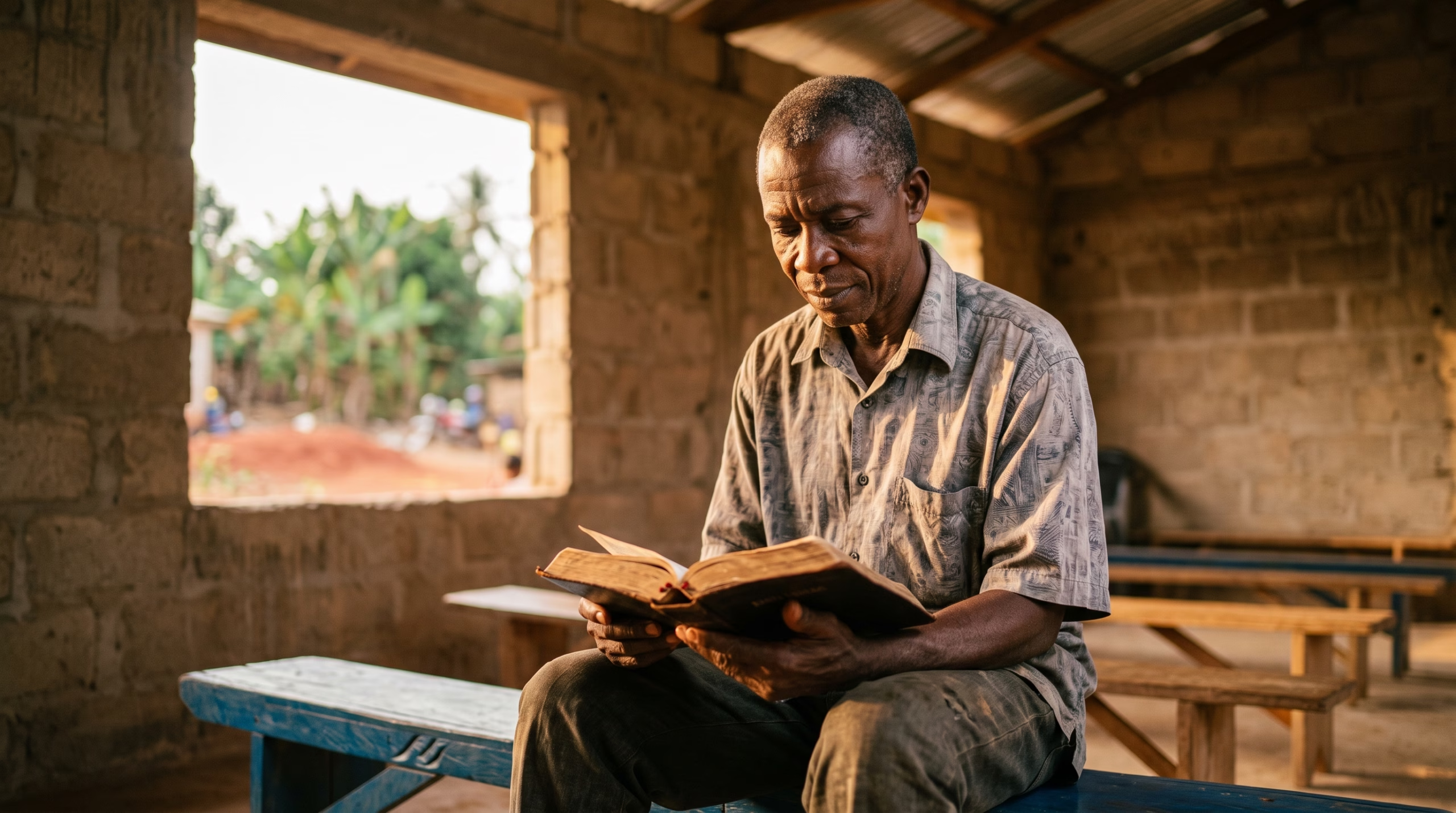
“`json
{
“title”: “Living in Ghana as a Missionary: Realities and Rewards of Service”,
“slug”: “living-in-ghana-as-a-missionary”,
“focus_keyphrase”: “living in Ghana as a missionary”,
“meta_description”: “Discover the daily realities and profound joys of living in Ghana as a missionary. Learn about challenges, culture, and the rewards of serving God.”,
“article_html”: “
I remember one afternoon, sitting under a mango tree in a village outside Accra, the dust settling on my Bible. The sound of children playing mixed with the distant call to prayer. My shirt was sticking to my back, and the air was thick with the smell of woodsmoke and something cooking over charcoal. That’s a typical moment when you’re living in Ghana as a missionary, a snapshot of the everyday reality that’s a world away from mission conference brochures. It’s hot, it’s messy, and it’s absolutely where God wants us.
For Laura and me, Ghana has been home for years. We’ve learned that the mission field doesn’t care much for your plans. Instead, it cares about your heart. It cares about your willingness to adapt, to sweat, and to keep going when everything around you seems to be falling apart. This is what it means to be a missionary in Ghana: it’s a constant exercise in faith, patience, and trusting that God is always at work.
The Daily Rhythm of Life and Ministry in Ghana
Our mornings usually start early, often with the sound of roosters or the local Muslim call to prayer. Breakfast might be tea and bread, or maybe some leftover local food from the day before. Then the work begins. It isn’t always glamorous, not by a long shot. Sometimes it’s translating a passage of scripture for a new convert. Other days it’s driving for hours on rough roads to visit a village where we’re planting a new church. Consequently, you learn to embrace the unpredictable.
Language is a big part of daily life. We speak English, but local languages, like Twi or Ga, open doors and hearts in ways English never can. I’ve spent countless hours stumbling through phrases, making mistakes that make the locals laugh. You study again. You visit again. You preach again. You forgive again. You trust God again. It’s a slow process, building relationships, but it’s the foundation of everything we do here. My wife Laura is a lot better at it than I am, I’ll tell you that much.
The mission field clarifies things quickly. It removes the padding. There are no stage lights and no weekly affirmation that you are doing well. There is only the work. This kind of work demands a fire in your bones, a passion that can’t be extinguished by hardship or delay. If you’re feeling that call, you’ll find a lot of encouragement and practical advice on our Missionary on Fire page.
Navigating Challenges While Living in Ghana as a Missionary
Challenges are not exceptions here; they are the normal course of events. We’ve dealt with power outages that last for days, water shortages, and vehicles that decide to break down in the most inconvenient places. I remember one time our truck died in a remote village, miles from any mechanic. We just pulled out our tools, prayed, and started working. We fixed it during the breaks between preaching sessions. That went about as well as you would expect.
The spiritual challenges are real, too. We’re on the front lines, sharing the Gospel where it hasn’t been heard, and the enemy doesn’t like that one bit. There are times of discouragement, times when we wonder if we’re making any difference at all. It’s in those moments that we lean hard on the Lord. The Bible tells us, “For we wrestle not against flesh and blood, but against principalities, against powers, against the rulers of the darkness of this world, against spiritual wickedness in high places” (Ephesians 6:12). That verse isn’t just theory here; it’s our daily reality.
One of the biggest struggles is the sheer scale of the need. We see so many people who have never truly heard the name of Jesus Christ. It can be overwhelming. The task is so immense, but our God is bigger. The International Mission Board estimates that more than 3.4 billion people still have little to no access to the gospel. That’s a staggering number, and it drives us forward every single day as we are living in Ghana as a missionary.
“More than 3.4 billion people still have little to no access to the gospel.”
International Mission Board
We’ve learned to celebrate small victories. One person getting saved. One family coming to church. One young man stepping up to lead a Bible study. Those moments fuel us. They remind us why we packed up our lives and moved across the world. They make every breakdown, every power cut, and every language mishap worth it.
The Joy and Fellowship of Ghanaian Culture
Despite the challenges, living in Ghana is also a profound joy. The people here are incredibly warm, hospitable, and full of life. They will share their last meal with you. They will welcome you into their homes. We’ve been invited to countless weddings, funerals, and naming ceremonies, all vibrant expressions of community and faith. You learn to drink a lot of “Milo” and eat a lot of “waakye.”
Building relationships takes time, especially when you’re planting churches. But once you’re in, you’re family. We’ve watched God raise up strong, faithful leaders from among the Ghanaian people. We’ve seen entire families come to Christ. There’s nothing quite like standing in a new church building, built by local hands, and hearing a congregation sing praises to God in their own language. That is victory.
This fellowship reminds me of the early church. They shared everything. They lived life together. That’s what we see happening in our churches here in Ghana. “Behold, how good and how pleasant it is for brethren to dwell together in unity!” (Psalm 133:1). That unity is a powerful witness to a lost world. It shows them the love of Christ in action.
Missionary on Fire Podcast
Preserving the Legacy of Faithful Missionaries
The Missionary on Fire podcast features interviews with veteran missionaries, classic sermons from the field, and stories of God’s faithfulness across generations. If you love the heart behind these stories, you will love the podcast. New episodes regularly.
Training and Equipping for the Work
Our mission is not just to preach, but to equip. We pour our lives into discipling new believers, teaching them the Word, and training them to lead their own churches. This means countless hours of Bible study, leadership seminars, and practical ministry training. It’s watching a young man, who started with nothing, grow into a powerful preacher of the Gospel. It’s a privilege to be a part of that.
We believe in the power of indigenous leadership. Our goal is to train Ghanaians to reach Ghanaians. They understand the culture, the nuances of the language, and the specific needs of their communities in ways we never fully will. We want to see strong, self-sustaining, Bible-believing churches led by faithful Ghanaian pastors. This is a key part of our vision and what we talk about often on our Missionary on Fire page.
This work isn’t for the faint of heart. It requires a deep commitment to God’s Word and a willingness to be refined by the fires of the mission field. We’ve seen interns come through our missionary internship program who thought they knew what they were getting into, only to realize the reality was far more demanding. Yet, it’s also far more rewarding. God uses every challenge to shape us into more effective servants.
What It Costs and What It Gives
There’s a cost to being a missionary in Ghana. You leave behind family, familiar comforts, and a certain level of convenience. You miss holidays, birthdays, and sometimes just a good cheeseburger. You learn to live without a lot of things you once considered necessities. Back home in Texas, problems were fixed through systems: forms, policies, and departments. But in Africa, systems do not run things; relationships do. I had to stop being a customer and become a friend. The cable did not get installed because of pressure. It got installed because of breakfast. It’s a different way of life, and it demands a different mindset.
Yet, what you gain far outweighs what you give up. You gain a deeper walk with God, a profound understanding of His faithfulness, and a front-row seat to His miracles. You gain a global family. You gain the incomparable joy of seeing souls transformed by the power of the Gospel. We’ve seen witch doctors forsake their ways and embrace Christ. We’ve seen hardened hearts softened. These are the treasures of the mission field, and they are eternal.
Sometimes folks back home ask me if I ever regret coming to Ghana. I just shake my head. There’s nothing to regret. God called us here. He sustained us here. He used us here. And He is still using us. We’re just ordinary folks, but we serve an extraordinary God. He can use anybody who is willing to say, “Here am I; send me.”
Being a missionary in Ghana isn’t a vacation. It’s not a temporary assignment. It’s a life poured out for Christ, in a place that desperately needs Him. It’s hard. It’s beautiful. It’s absolutely worth it. If you feel the stirring of God in your heart for missions, don’t let “someday” be a thief. Explore what it truly means to be a Missionary on Fire and consider how you might answer God’s call.
“About 84% of the world’s population identifies with a religious group, yet many have not heard the Gospel.”
Pew Research Center

Joe Consford is a Baptist missionary serving in Ghana, West Africa, with his wife Laura. He writes about missionary life, missions training, and the work of the Gospel in West Africa at consfords.com.
Frequently Asked Questions
What is it like to be a missionary in Ghana?
Being a missionary in Ghana involves daily adaptation to local rhythms, often starting early with roosters or calls to prayer. It means embracing unpredictable challenges like power outages and vehicle breakdowns, while building relationships and sharing faith in local languages like Twi or Ga. Living in Ghana as a missionary is a constant exercise in faith.
What are the biggest challenges for missionaries living in Ghana?
Missionaries in Ghana frequently face practical challenges such as prolonged power outages, water shortages, and vehicle breakdowns in remote areas. Beyond logistics, adapting to cultural nuances and patiently building trust through language learning are significant aspects of living in Ghana as a missionary.
How important is learning local languages for missionary work in Ghana?
Learning local languages like Twi or Ga is crucial for effective missionary work in Ghana. While English is spoken, local languages open doors to deeper relationships and hearts in ways English cannot. It’s a slow process of study and practice, but it forms the foundation of ministry.
What kind of daily ministry activities do missionaries undertake in rural Ghana?
Daily ministry in rural Ghana can involve translating scripture for new converts, driving long distances on rough roads to plant new churches, and engaging in community life. Missionaries often find themselves fixing vehicles between preaching sessions, demonstrating a hands-on approach to living in Ghana as a missionary.
”
}
“`