Missions With the Consfords
July 7, 2026
I remember sitting in a small, dusty village in Ghana, trying to explain the concept of eternal life to an elder who spoke mostly Ewe. My Twi was getting better,…
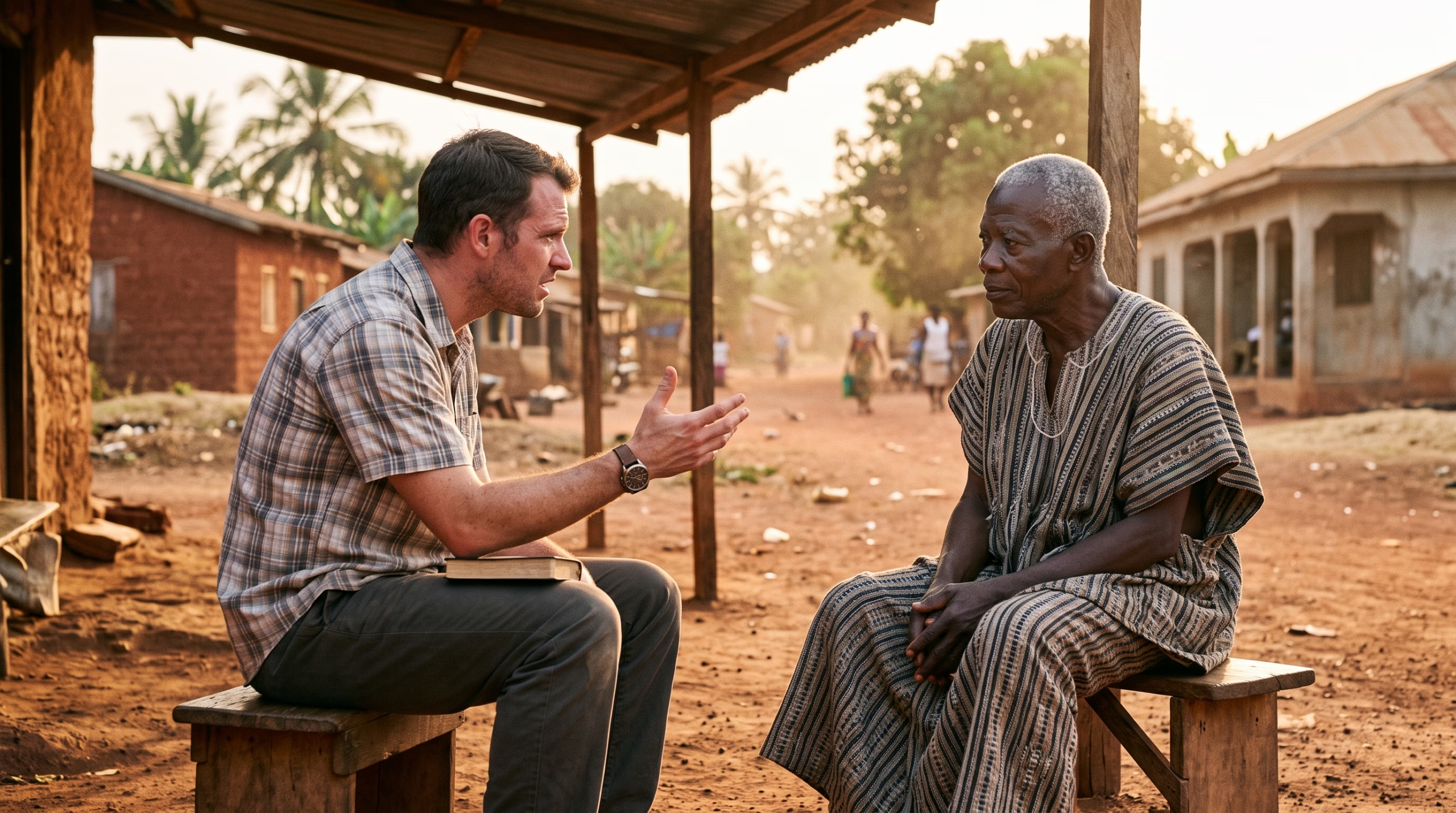
I remember sitting in a small, dusty village in Ghana, trying to explain the concept of eternal life to an elder who spoke mostly Ewe. My Twi was getting better, but Ewe was a different beast. He nodded politely as I spoke, his eyes kind, but I could tell by the slight tilt of his head that my words were hitting a wall. He understood the words, maybe, but not the weight behind them. That moment, like so many others, showed me just how vital effective cross-cultural communication for missionaries truly is.
It’s not just about learning a new language. That’s a huge part of it, of course, and you’ll spend years at it. But real communication goes deeper than vocabulary lists and verb conjugations. It’s about bridging worlds, understanding unspoken rules, and earning the right to be heard. It’s the daily work of building trust and showing respect, even when you’re fumbling for the right phrase.
Beyond Words: The Language of the Heart
When we first arrived in Ghana, my wife Laura and I quickly learned that what we said was often less important than how we said it, or even what we didn’t say. A direct “no” can be rude in some cultures, for example. People might say “yes” just to be polite, even if they mean “no,” and you have to learn to read between those lines.
The mission field clarifies things quickly. It removes the padding. There are no stage lights and no weekly affirmation that you are doing well. There is only the work. You study again. You visit again. You preach again. You forgive again. You trust God again. The mission field does not reward drama. It rewards endurance, and that endurance often comes down to patient, careful communication.
Understanding the local worldview is like learning a second language itself. You have to grasp what people value, what they fear, and what gives them hope. Only then can you begin to share the Gospel in a way that truly resonates, that speaks to their heart and not just their ears. The Apostle Paul knew this, didn’t he? He said in 1 Corinthians 9:22, “To the weak became I as weak, that I might gain the weak: I am made all things to all men, that I might by all means save some.” That’s the heart of it right there.
Listening is Ministry: Understanding Before Speaking
I remember one time I was trying to explain the concept of a personal relationship with Christ to a group of men in a new village. I used all the right words, I thought, and kept it simple. But their faces were blank. Finally, one man asked, “But what about our ancestors? Will they be in this heaven you speak of?”
That went about as well as you would expect. I had completely missed a core cultural concern. My neat theological categories didn’t account for their deep respect for those who had gone before. I had to stop talking and start listening. Truly listening. Sometimes, the most powerful tool in cross-cultural communication for missionaries is not your mouth, but your ears.
You have to ask good questions. You have to be willing to sit in silence and let people think. You have to let them voice their concerns, their traditions, their misunderstandings. We can’t expect people to adopt our American way of thinking about God, even if the truths of God are universal. We need to present those truths in a way that respects their context.
One of the biggest lessons Laura and I have learned is that our job isn’t to transplant American church culture to Ghana. Our job is to plant the seed of the Gospel and let God grow a Ghanaian church. That means letting local believers lead, learn, and grow in their own cultural expression of faith. If you want to see how we tackle these kinds of challenges daily, you can check out my book, Missionary on Fire, where I share a lot more about these experiences.
“Over 3.2 billion people live in unreached people groups, meaning they have little to no access to the Gospel.”
IMB
The Gospel is Simple, The Delivery Isn’t
Explaining abstract theological concepts across cultures can be a real head-scratcher. Terms we take for granted, like “grace,” “redemption,” or “sin nature,” might not have direct equivalents in another language or worldview. You can’t just translate the word; you have to translate the concept.
I remember trying to explain “grace” to a man who understood everything in terms of reciprocal obligations and deserved outcomes. The idea of receiving something completely undeserved, freely given, was almost offensive to his sense of justice. It took time, parables, and real-life examples before the light finally clicked for him. We had to find common ground in their understanding of kindness and generosity, then elevate it to God’s divine kindness.
This is where patience becomes a virtue, and prayer becomes a lifeline. We pray for wisdom daily, asking God to open doors of understanding, both for us and for the people we serve. The Holy Spirit is the ultimate translator. You can learn more about how the Bible has been translated into thousands of languages to reach people groups all over the world by visiting Wycliffe Bible Translators. They do incredible work.
The Bible tells us in Proverbs 15:23, “A man hath joy by the answer of his mouth: and a word spoken in due season, how good is it!” That “due season” often means waiting, observing, and then speaking the truth in a way that is both clear and culturally appropriate. It’s about timing and sensitivity.
Missionary on Fire Podcast
Preserving the Legacy of Faithful Missionaries
The Missionary on Fire podcast features interviews with veteran missionaries, classic sermons from the field, and stories of God’s faithfulness across generations. If you love the heart behind these stories, you will love the podcast. New episodes regularly.
Building Bridges, Not Walls: Cultural Adaptation
Part of effective cross-cultural communication for missionaries is knowing when to adapt and when to stand firm. We don’t compromise on the truth of the Gospel, not for a minute. But how we present that truth, the customs we observe, the way we engage socially – those are areas where flexibility is key.
Take food, for example. I’m a Texan. I like my food a certain way. But when you’re invited to eat with a family in Ghana, you eat what’s offered, and you eat it with gratitude. Even if it’s fufu and palm nut soup at 7 AM, and you’re still processing the fact that you’re supposed to eat it with your right hand. I may have praised the Lord loud enough for the whole building to hear when I finally got the hang of it.
It’s about demonstrating humility and respect. When you show people you value their way of life, they are more likely to listen to what you have to say about eternal life. We want to be a blessing, not a burden, and that means being a good neighbor in every sense of the word. You can read more about our daily life and the challenges we face in our prayer letters, which we send out regularly.
Sometimes, adapting means embracing new rhythms. Things move at a different pace in Ghana. Meetings might start late. Plans might change unexpectedly. At that point I looked at my wife and asked if we had made a wrong turn and wound up in Africa. That’s just the way it is. You learn to flow with it, to be patient, and to trust that God’s timing is perfect, even when it doesn’t align with your Google Calendar.
Learning Never Ends: Humility and the Holy Spirit
After years on the field, I can tell you this: you never stop learning. Every new village, every new conversation, every new believer brings fresh insights and new challenges. The moment you think you’ve got it all figured out, that’s usually when God throws you a curveball just to remind you who’s really in charge.
Humility is essential. We come as servants, not as experts. We come to share the greatest news in the world, not to impose our cultural preferences. We rely on the Holy Spirit to guide our words, to open hearts, and to convict of sin and righteousness. He’s the one who truly enables effective cross-cultural communication for missionaries.
We are just the vessels. We get to speak, to teach, and to love, but it’s God who gives the increase. This journey of faith and ministry is something Laura and I are passionate about sharing. We believe every believer has a part to play in fulfilling the Great Commission. If you feel a tug on your heart about missions, or just want to learn more about what it takes to serve, I encourage you to check out the resources on our Missionary on Fire page. You’ll find stories, insights, and ways you can get involved.
The work of sharing the Gospel across cultures is challenging, messy, and infinitely rewarding. It stretches you in ways you never imagined, but it also shows you the incredible power of God to break down barriers and unite people from every tribe and tongue. It is absolutely worth every struggle. Keep learning. Keep praying. Keep going.

Joe Consford is a Baptist missionary serving in Ghana, West Africa, with his wife Laura. He writes about missionary life, missions training, and the work of the Gospel in West Africa at consfords.com.
Frequently Asked Questions
What are the biggest challenges in cross-cultural communication for missionaries?
The biggest challenges often involve language barriers, understanding unspoken cultural norms, and grasping different worldviews. Missionaries must learn to read between the lines, interpret non-verbal cues, and adapt their message to resonate with local values and concerns, moving beyond mere translation to true comprehension.
How do missionaries overcome language barriers beyond just learning vocabulary?
Beyond vocabulary, missionaries overcome language barriers by immersing themselves in the culture, observing social interactions, and learning the nuances of politeness and indirect communication. They focus on building relationships and trust, which often allows for more effective cross-cultural communication for missionaries even with imperfect language skills.
What role does listening play in effective cross-cultural communication on the mission field?
Listening is paramount in effective cross-cultural communication for missionaries. It allows them to understand local concerns, values, and fears before speaking. By truly listening, missionaries can identify cultural blind spots in their own message and adapt their approach to share the Gospel in a way that genuinely connects with the audience’s heart and worldview.
How can missionaries address deep-seated cultural beliefs, like ancestor veneration, when sharing the Gospel?
Missionaries address deep-seated cultural beliefs by first listening and understanding their significance within the local worldview. They then seek to present the Gospel in a way that acknowledges these concerns, showing how Christ offers a fulfilling answer without disrespecting cultural heritage. This requires sensitivity, theological depth, and often, long-term relationship building.